
Rule-Based Chatbots vs. AI Agents: A Technical Comparison
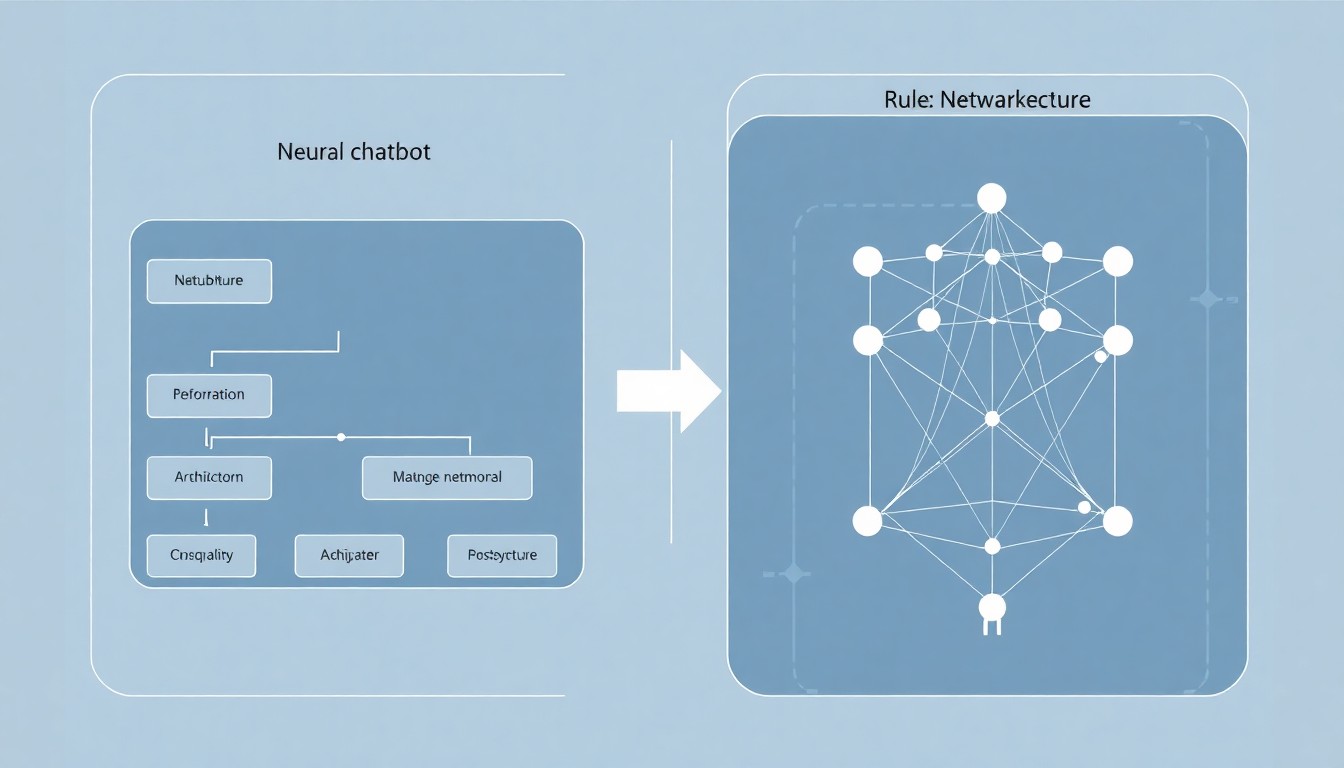
Today the word “chatbot” covers two fundamentally different technologies. Rule-based chatbots follow predefined paths, while AI agents understand free-form language and can use tools such as the calendar or CRM on their own. This technical comparison of rule-based chatbots vs. AI agents explains how the two approaches are built, where their strengths and weaknesses lie and why a combination often works best in practice.
How a rule-based chatbot works
At its core, a rule-based chatbot is a decision tree. Someone has defined in advance which questions the bot asks, which answers it expects and where each answer leads. Buttons are often used (“Book appointment”, “Opening hours”, “Order prescription”) so that the user does not have to type freely at all. Somewhat more advanced systems recognise keywords or trained intentions, known as intents, and map a free-text input to a prepared path.
The big advantage is predictability. You know exactly what the bot will say, because every sentence has been written and approved in advance. That makes it auditable and attractive for sensitive processes. The disadvantage shows as soon as a customer strays from the intended path. If someone writes “My son has had a fever since yesterday, can we still come in today, but only after school?”, a simple bot may recognise “appointment” but lose the rest. The result is the familiar loop of “Sorry, I didn't understand that”.
How an AI agent works
An AI agent is based on a large language model. Instead of fixed paths, it is given a task, rules and access to tools. A request roughly passes through these steps:
- Understanding: the language model grasps the intention and the details of the message, even when several requests are packed into one sentence.
- Retrieving knowledge: relevant information is fetched from an approved knowledge base, such as opening hours, services or prices.
- Using tools: the agent checks free slots in the calendar, creates a contact in the CRM or sends a confirmation.
- Answering or handing over: it formulates a reply in natural language or passes the case to a person according to defined rules.
This means an agent can also handle unexpected wording and conduct a conversation over several steps. The price is lower predictability. A language model can phrase a wrong answer convincingly if it is not properly restricted to approved sources. The article Large language models in sales explains how language models work in principle.
A common misconception: AI agents do not automatically learn during operation. Improvements come about because someone extends the knowledge base, adjusts rules or reviews conversation histories. So both approaches need maintenance; it just looks different.
Rule-based chatbots vs. AI agents side by side
| Criterion | Rule-based chatbot | AI agent |
|---|---|---|
| Language understanding | Keywords, buttons, predefined intents | free-form language, several requests, follow-up questions |
| Predictability | very high, every sentence is approved | lower, has to be safeguarded with rules and source restrictions |
| Maintenance effort | every new question needs a new path | keep knowledge base and rules up to date, review histories |
| Channels | mostly website chat, sometimes messengers | chat, messengers, email and phone with speech processing |
| Actions | fixed processes, for example a form | flexible use of calendar, CRM and other systems |
| Typical errors | does not understand the question, customer gives up | answers too freely if limits are missing |
| Auditability | simple, paths can be tested completely | through spot checks, test cases and conversation logs |
Actual project costs depend heavily on scope, channels and interfaces. Blanket statements about which approach is cheaper are of little help. Besides setup, always factor in the ongoing maintenance effort.
Why a combination is often best
In practice you do not have to pick a side. Many good systems use an AI agent for the conversation and fixed rules for critical moments. An example from a GP practice shows this:
Patients write in the chat or call to book appointments, ask about prescriptions or enquire about test results. The AI agent understands the requests and books appointments directly in the practice calendar. Certain situations, however, are governed by fixed rules. If someone describes symptoms that point to an emergency, such as chest pain or shortness of breath, the assistant gives a fixed notice about the emergency number 112 and the out-of-hours medical service 116 117, regardless of how the conversation has gone. Questions about test results or diagnoses are always passed to the practice team, because medical confidentiality and medical responsibility apply here. These rules are not left to the language model; they are hard-wired.
The same principle applies in sales: the agent conducts the conversation, but discounts, contract changes or cancellations follow fixed procedures or go straight to a person. Neurobots' AI employees are built on this pattern: they hold conversations by phone, chat, WhatsApp and email, book appointments and hand over to your team at defined points.
Which approach suits you
A rule-based chatbot is enough if your customers keep asking the same few questions, which can be mapped well with buttons, and if you need maximum control over every sentence. A table reservation system with three selection fields does not need a language model.
An AI agent is the better choice if customers phrase things freely, mix several requests, call on the phone, or if conversations are meant to trigger actions in several systems. This typically applies to practices, workshops, estate agents and service providers with many different enquiries. The article Chatbot analytics describes how to measure success later on. For a side-by-side view of everyday use, see the comparison AI employee vs. chatbot.
When switching is not worth it
If your existing bot resolves most enquiries well, customers rarely give up and the team hardly gets any follow-up questions from the chat, there is little reason to switch. And if nobody has time to build a knowledge base and review conversation histories, a simple, well-maintained decision tree is more reliable than a poorly looked-after agent. Before deciding, check your current bot's logs: where do users give up, and which questions end up as “not understood”? This list shows whether an agent would actually help there. The step-by-step guide for non-technical teams describes how a project runs without in-house developers.
Whatever the approach, under the EU AI Act you should disclose that customers are talking to an AI. And for personal data, health data above all, you need a data processing agreement and data processing that complies with the GDPR.
Frequently asked questions
Can I keep using my existing chatbot?
Often, yes. The existing paths and answers are a good foundation for an agent's knowledge base. Critical processes can be kept as fixed rules.
How do I stop an AI agent from saying something wrong?
Restrict it to approved sources, define when it has to hand over, and test with difficult questions before launch. Read conversation histories regularly in the first weeks.
Is an AI agent the same as an “agentic AI” system?
The terms overlap. “Agentic AI” usually describes systems that plan and carry out several steps on their own. More on this in the article Agentic AI in sales.
Conclusion
Rule-based chatbots are predictable but rigid. AI agents understand people much better but need clear limits. For most businesses with varied enquiries, an agent with fixed rules for critical situations is the most sensible route. The page AI practice assistant for medical practices shows what this looks like in a practice.
Neurobots for your industry
See how AI employees handle inquiries and appointments in your industry.
View all industry solutionsNote: This article is for general information only. It is not legal advice and was not written or reviewed by lawyers. For your specific situation, please consult a lawyer. All information is provided without guarantee.
Related Articles
AI Sales Tools 2026 Compared: Tool Categories and Selection Criteria
AI sales tools 2026 compared by category: what CRM AI, outreach, AI employees and forecasting tools do, and how to check them before you buy.
AI Email Marketing Tools Compared: What Is Really Worth It?
Which AI features in email marketing are useful, which tool categories exist and how to test the benefit on your own list while staying legally compliant.

AI vs human sales reps: an honest comparison of performance and cost
Where AI is stronger in sales, where people remain irreplaceable, how to compare costs fairly and which division of labour works.
AI Automation for Your Business
Let's find out together which of your processes can be automated with AI employees — free and without obligation.
Book a free consultationROI
Calculated before the start, measured continuously